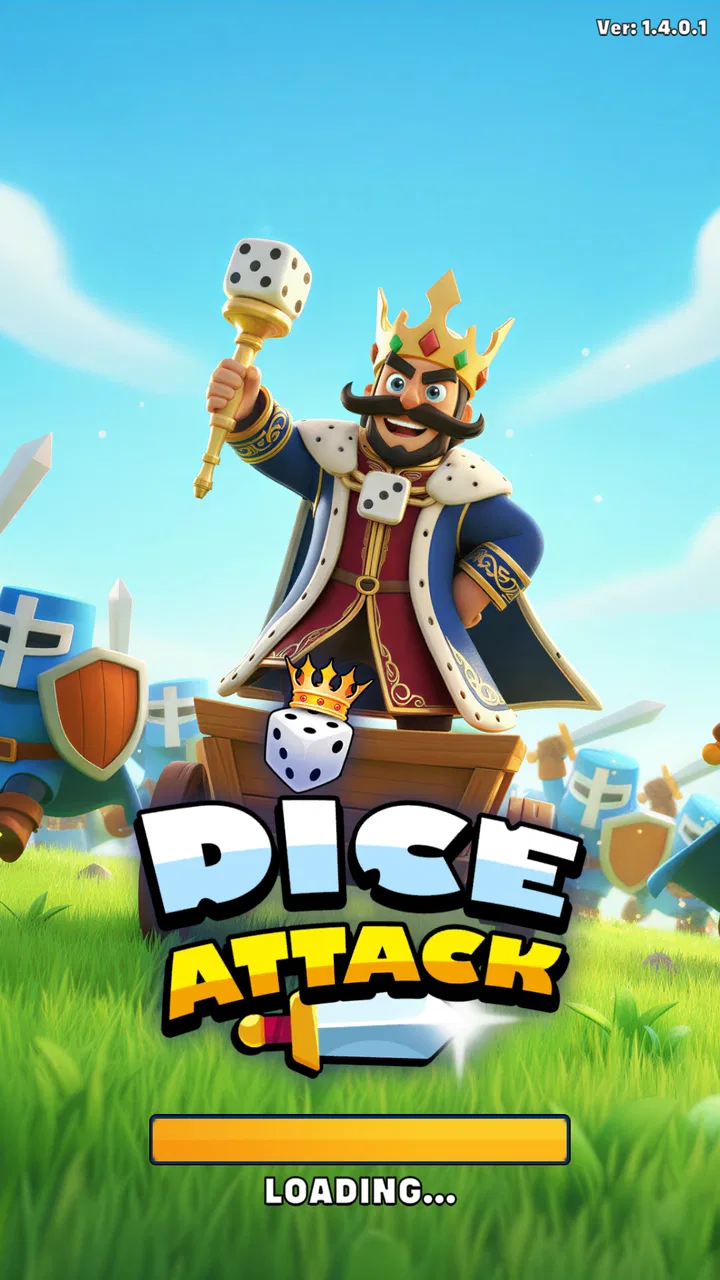
Dice Attack : Roguelike Battle
- 4.0
- Rating
- 100.00K
- Installs
- Free
- Price

 Analysis by App-foxy
I approached Dice Attack: Roguelike Battle as a quick strategy game rather than a traditional board game with dice added on top. Its central appeal is the tension between a random roll and the decision that follows: I may not receive the exact result I want, but I still need to decide how to turn that result into a stronger attack, a safer position, or a better chance in the next encounter. That makes it easy to start, while leaving room for thoughtful play.
This is a free strategy game from Fun Games Teknoloji, rated Everyone and available for devices running at least Android 11. It has reached over 100 thousand installs and holds an average rating of 4.2 from around 2.1 thousand ratings. Those figures suggest a healthy audience without making the game feel like a massive mainstream production. I see it as a compact choice for players who enjoy short tactical sessions, light roguelike decision-making, and the satisfaction of building momentum from uncertain outcomes.
What I would consider before choosing it
I’d weigh the dice-driven uncertainty against the kind of control I want from a strategy game. A useful test is whether I enjoy adapting a plan after an inconvenient result, rather than wishing the game would let me choose every outcome. I’d also decide in advance whether a free-to-play game with optional purchases fits my habits; with that settled, the question becomes whether its short tactical loop keeps rewarding my attention.
You May Also Like

 Blood Strike: 2.5 Anniversary
Blood Strike’s Loadouts Turn Every Drop Into a Tactical Gamble
A close look at Blood Strike’s custom loadouts: how fast access to signature weapons reshapes its battle royale rhythm, rewards preparation, and narrows the gap between fights.

 Pandora - Music & Podcasts
Pandora’s Music Is Easy to Start, but Harder to Recover
Pandora’s strength is its low-effort path from a seed to a station. Its weak spot is how much confidence it asks you to place in connection, setup, and quiet recovery.

 8 Ball Pool
 Is Built on Rivalries, Rematches, and Routine
A close look at the rivalries, rematches, shared routines, and unanswered safety questions that turn a quick pool match into a persistent mobile community.

 Samsung Music
’s Quiet Strength Is Playing What You Already Own
Its reach comes less from spectacle than from dependable access to a personal library. That simplicity is both the app’s strongest retention engine and its ceiling.

 AccuWeather: Weather Radar
AccuWeather Review: A Quick, Clear Forecast for Everyday Decisions
For everyday plans, the best forecast is the one you can understand quickly. AccuWeather makes rain timing, radar, and local conditions easy to act on, with a few trade-offs.

 Hill Climb Racing
Why Hill Climb Racing Still Turns Crashes Into One More Run
A tiny car, a bumpy hill and one more upgrade: Hill Climb Racing keeps resurfacing because its simple chaos makes every near-miss feel personal.
More From Our News Desk
View All News


The main question is how much randomness you enjoy
The first decision is simple: do you want a strategy game where every move is fully predictable, or one where you must adapt to imperfect results? Dice Attack is built around the second type. The dice are not just a visual theme; they shape the rhythm of each battle and force me to reconsider my plan as the situation changes. If you enjoy making the best of a mediocre roll, the design has a natural appeal. If you prefer careful planning with complete control, the same system can feel frustrating.
I found the game most interesting when I stopped treating every roll as a demand for a perfect outcome. A weaker result can still be useful if I use it to protect an advantage, prepare for the next exchange, or avoid spending a valuable option too early. That mindset is important because the game’s enjoyment comes less from commanding a flawless army and more from managing uncertainty.
Short sessions matter more than long campaigns
This is a good fit for the gaps in a normal day. I can imagine playing while waiting for an appointment, during a short commute, or between other tasks without needing to commit to a long uninterrupted session. The straightforward premise helps: roll, assess the battlefield, and choose how to push the attack forward.
That convenience also defines the game’s limits. Players looking for a deep, story-heavy strategy experience with extensive world-building may find the focus too narrow. Dice Attack is better understood as a repeatable tactical loop than as a large role-playing adventure. Its value depends on whether that loop stays enjoyable after the novelty of the dice has settled.
Free access is useful, but spending changes the decision
The game can be downloaded for free, which makes trying it relatively easy. However, in-app purchases range from $0.99 to $99.99 per item. I would therefore approach it with a clear personal spending limit before getting invested. The free entry point is a strength for curious players, but the broad purchase range means the game deserves the same budget awareness as other mobile strategy titles.
My advice is to play long enough to decide whether the basic battle rhythm works for you before considering any purchase. A purchase cannot fix a mismatch between your preferred style and the game’s reliance on dice. If you already like the core loop, optional spending may feel more meaningful; if you do not, paying more is unlikely to change that first impression.
What the age rating tells me about its audience
The Everyone rating makes the game approachable for a broad audience. It is a reasonable option for someone who wants strategy without an intimidating presentation or a mature theme. Still, an accessible age rating does not mean every player will enjoy it. Younger or casual players may appreciate the immediate dice concept, while experienced strategy fans may want more control and more elaborate planning than this format provides.
For households sharing a device, I would still treat it as an individual game rather than assuming everyone will enjoy the same style. One person may like the excitement of an unexpected result, while another may see randomness as interference. The rating describes suitability of content, not depth or difficulty.
How I would compare it with familiar strategy alternatives
Compared with a classic turn-based strategy game, Dice Attack feels lighter and more immediate. Traditional alternatives often reward studying a large map, managing several resources, and planning many turns ahead. Here, the attention is concentrated on the current battle and the consequences of the latest roll. That makes it easier to learn, but it may not provide the same sense of commanding a broad campaign.
Compared with a pure dice game, it asks for more interpretation. I am not simply hoping for a high number; I am deciding how to use the result in a tactical context. Compared with an action game, it is calmer and less dependent on reflexes. Those comparisons help clarify its audience: it sits between casual randomness and deliberate strategy, rather than trying to replace a full-scale strategy experience.
Where Dice Attack earns its place
For me, the lasting appeal is in using each brief session to practice a different judgment: when to accept risk, when to preserve options, and when not to chase a bad result. That gives the game a modest routine rather than demanding a long campaign, which suits spare moments but may not satisfy someone looking for broad progression. I’d keep it installed if those small decisions stay enjoyable after the first-week novelty wears off.
The roll creates decisions instead of removing them
The strongest part of the design is the way randomness can create a decision point. A disappointing roll does not automatically end the battle, and a strong roll does not remove the need to think. I have to judge whether the immediate attack is worth taking, whether a defensive response is wiser, and whether I am using a result that could be more valuable later.
The useful skill is not predicting the dice; it is protecting your options when the dice disagree with your plan. That is a more interesting form of strategy than simply repeating the same optimal move. It rewards flexibility, especially for players who enjoy adjusting their approach rather than following a fixed solution.
It makes a good low-pressure entry into roguelike strategy
Roguelike games can sometimes overwhelm new players with layered systems, permanent upgrades, branching maps, and complicated explanations. Dice Attack presents a more approachable route into that style of play. The battle concept is easy to understand, and the repeated cycle encourages experimentation. I can test a more aggressive approach, learn from a poor result, and try a different response without needing to study a large manual first.
That simplicity is not only useful for beginners. Experienced players may enjoy it as a palate cleanser between more demanding games. I would not choose it when I want a long evening of detailed optimization, but I would choose it when I want a compact decision-making exercise that can be picked up quickly.
My practical tip: separate a bad roll from a bad decision
One of the easiest mistakes is to judge a turn only by its visible result. If an attack fails, it is tempting to conclude that the choice was wrong. In practice, I found it more useful to ask whether the decision was reasonable with the information available at the time. A cautious move that preserves future possibilities can be correct even when it does not produce an immediate win.
This approach also reduces the feeling that the game is unfair. I cannot control every roll, but I can control how much risk I accept around it. When I commit everything to a single hoped-for outcome, a poor result feels devastating. When I keep a backup plan, the same result becomes a problem to solve rather than a reason to quit.
It works particularly well for players who like replayable routines
The game’s appeal comes from repeating a familiar structure while making different choices inside it. That is useful for players who enjoy improving their judgment rather than simply unlocking a long sequence of content. Each session can become a small test of risk management: attack now, wait for a better opportunity, or use a limited advantage to stabilize the situation.
I would recommend playing with a specific goal instead of chasing endless progress. For example, I might focus on learning when to take an aggressive roll or on avoiding unnecessary risks during a difficult stretch. This turns a short session into a deliberate practice exercise and makes the game feel less like passive time-filling.
The current version is a sensible starting point
The current version is 1.5.3, and that gives new players a clear version reference when checking compatibility or discussing the game with others. I would not read the version number as a promise of a particular feature set, but it does make it easier to know which build I am using when troubleshooting or comparing experiences.
For anyone considering installation, the Android 11 minimum is worth checking first. On a compatible device, the game is positioned as a modern mobile strategy option rather than an older title designed for very early Android hardware. That requirement may exclude some older phones, so compatibility should be part of the decision before downloading.
A realistic everyday scenario
Imagine I have ten minutes before leaving for work. I do not want to begin a huge campaign that demands concentration for an hour, but I also do not want a completely mindless distraction. Dice Attack fits that moment because the roll gives me an immediate problem and the tactical choice gives the session some substance. I can play with a small objective, stop when I need to, and return later without having spent the whole break managing a large strategic empire.
Another useful scenario is playing after a demanding day when I want decisions without fast reactions. The game can provide a little mental engagement while remaining more relaxed than a competitive action title. The trade-off is that repeated sessions may feel similar if I need constant narrative surprises or a large variety of mechanics.
Where the experience may become less comfortable
Randomness is also the game’s most obvious source of friction. A player can make a sensible choice and still receive an outcome that weakens the position. Over time, that can test patience, especially for someone who equates strategy with direct control. I would skip this game if unlucky outcomes routinely make me feel that my decisions do not matter.
The free-to-play structure is another reason to stay attentive. The purchase range is wide, so I would avoid tapping through offers casually. Players who prefer a single upfront payment may feel more comfortable with a premium strategy game, even if its initial price is higher, because the spending model is easier to understand from the beginning.
Who should choose a different kind of game
I would point a competitive player toward a more control-focused strategy alternative if they need precise planning, clear long-term optimization, or a strong multiplayer ranking structure. I would also suggest a conventional roguelike with deeper character development to someone who wants extensive build experimentation and a more elaborate progression journey.
Likewise, players who mainly want a relaxing casual game with almost no failure may prefer a puzzle or idle title. Dice Attack asks me to accept risk and learn from outcomes. Its accessible presentation does not remove the possibility of frustration, and that distinction matters when choosing a game for relaxation.
The cost of switching is low, but the habit is the real investment
Because the game is free to download, trying it does not require the same initial commitment as buying a premium strategy title. The bigger cost is attention. If I start treating purchases as a way to compensate for unlucky sessions, the game can become less enjoyable and less predictable as a hobby.
I would handle the transition from another strategy game by keeping expectations modest. Do not expect a large map, a complex economy, or the same planning horizon. Instead, carry over the useful habits: observe before acting, estimate risk, and avoid spending every advantage at once. Those habits transfer well, while the slower, more expansive systems of a traditional strategy game do not.
A practical switching test is to play several short sessions without spending anything and note whether the decisions remain interesting after the first excitement fades. If I am still thinking about better ways to manage a weak roll, the game has probably earned a place on my phone. If I am only waiting for luck to improve, another category would be a better fit.
My recommendation for different types of players
I recommend Dice Attack to casual strategy players who enjoy dice-based uncertainty, short sessions, and the challenge of turning imperfect outcomes into useful moves. It is also a good starting point for someone curious about roguelike battles but not ready for a dense, system-heavy game. The Everyone rating and free download make it easy to explore, while the 4.2 average from around 2.1 thousand ratings indicates that many players have found the basic experience worthwhile.
I would recommend it with more caution to dedicated strategy fans. If your enjoyment comes from eliminating randomness and planning far ahead, this may feel too dependent on chance. If you are comfortable with risk and enjoy adapting under pressure, the same feature becomes the reason to keep playing.
My final view is that this is a focused game with a clear identity. It does not need to imitate a full strategy campaign to be useful; its strength is the compact argument between luck and judgment. I like it most when I play deliberately, set a spending boundary, and treat each roll as a problem rather than a verdict. For that kind of player, Fun Games Teknoloji has made a free mobile strategy option worth trying. For anyone seeking total control, a long narrative, or a one-time purchase experience, I would choose a different alternative instead.
FAQs for Dice Attack : Roguelike Battle
01What is the main objective of Dice Attack: Roguelike Battle?
Dice Attack: Roguelike Battle combines strategy and chance, where players use dice to engage in battles against various enemies. The main objective is to progress through levels by strategically rolling dice to attack foes, while managing resources and upgrading abilities. Each playthrough offers a unique experience due to the roguelike elements.
02How does the roguelike element influence gameplay in Dice Attack?
In Dice Attack, the roguelike elements mean that each playthrough is procedurally generated, providing a unique experience every time. When you lose, you start over, but you can unlock new abilities and dice to help in future attempts. This adds a layer of replayability and strategic depth as you learn and adapt.
03What are the in-app purchase options available in Dice Attack?
Dice Attack offers various in-app purchases that enhance gameplay. Players can buy currency to unlock special dice, abilities, or character skins. These purchases are optional and designed to provide additional customization and convenience, but they are not necessary to enjoy or complete the game.
04Is Dice Attack suitable for all ages?
Dice Attack: Roguelike Battle is designed to be accessible to a wide audience, featuring cartoonish graphics and straightforward mechanics. However, the strategic nature of the game and some battle scenarios might be challenging for very young children. It's best suited for players who enjoy strategy games with a bit of luck involved.
05Are there any social or multiplayer features in Dice Attack?
As of now, Dice Attack is primarily a single-player experience focused on individual strategy and progression. There are no direct multiplayer or social features, but players can share their achievements and progress on social media platforms to compete with friends indirectly.
Pros
- Engaging roguelike mechanics enhance replayability.
- Varied dice abilities keep battles interesting.
- Simple interface is easy for beginners to grasp.
- Strategic depth for players seeking a challenge.
- Frequent updates add new content regularly.
Cons
- Can be repetitive after extended play.
- In-app purchases can be intrusive.
- Some levels feel unbalanced in difficulty.
- Graphics are simplistic
- lacking detail.
- Requires internet connection for full features.

Dice Attack : Roguelike Battle
Gallery